
 Image 1 of 1
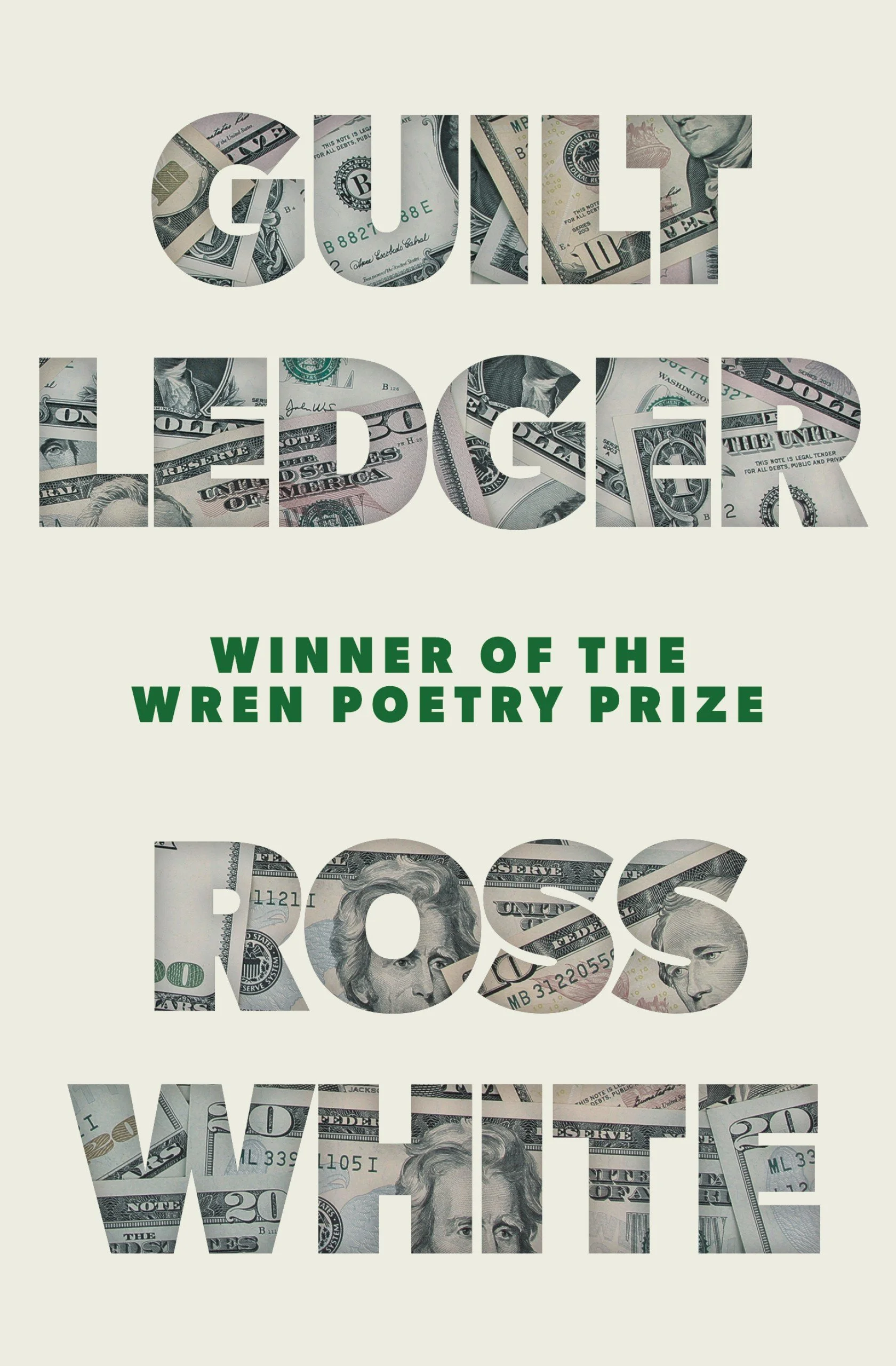
Winner of the Wren Poetry Prize selected by Sandra Beasley
“Law firms, rock bands, high school cliques, the U.S. government—in Ross White’s Guilt Ledger, these groups are no different than family, all as united and strong as the offenses they keep hidden. White hides nothing in this collection, in which the teller is money handler, yes, but also the oldest of confessors—the poet. While turning his gaze toward the last years of the greedy Reagan Era, White whistleblows on the difficult business that is the contract between father and son, “Isn’t love, / too, work?” Ross White is a poet who keeps me guessing with each line, each image, each tonal leap, each collection. Guilt Ledger is a work of art.” —Tommye Blount, author of Fantasia for the Man in Blue
“Guilt Ledger tells a story of inheritances and indelible impressions—‘Consider each family a mint of sorts,’ it declares. Ross White’s collection captures a very particular era of American banking scandal, but it is about so much more. Among the poet's formidable talents are his ability to use unexpected vessels for portraiture, pattern-making, and dark humor. ‘Today they fired the receptionist,’ observes ‘Downsizing.’ ‘Today they fired the efficiency expert who conducted the first round of firings. / . . . They fired the list of fireable offenses. / . . . Fired the hand that could no longer sign its name.’
Those who have passed through Washington, D.C., will recognize the martini-brine of ‘temples to transactionality’ and feel the particular thrill of the Red Line metro whooshing past. Reading Guilt Ledger opens a door for me—to talking about economic wreckage, mistakes of our fathers, mistakes we keep making—and I find myself deeply grateful for these daring, profoundly moving poems.” —Sandra Beasley, author of Made to Explode
“This is an important book of poems in this moment and in every other moment. Ross White has written a book that clearly and heartbreakingly shows us the costs of late capitalism. The way banks and the money they are (supposedly) full of control the day-to-day keys to health, happiness, and human dignity. Like Mark Nowak, Antler, and Phil Levine, Ross White is willing to move past the romantic vision of work and struggle and show the deep human cost of the late capitalist machine. The poems are wrought with a tremendous attention to poetic craft while also allowing a new kind of looseness driven by vulnerability and rage that brings us into a new era and understanding of the work of one of the great community builders in the poetry world. This seems, to me, a book where all of Ross White's gifts come together. He has stepped into his own here and, as a result, reveals he is part of a radical poetic lineage one might not have perceived before. It's bracing and exciting. This book made me reconsider a poet whose work I already loved. That's rare. This book is a confirmation of White's exceptional talent and a new era of his place in the world of poetics.” —Gabrielle Calvocoressi, author of The New Economy
In Guilt Ledger, money is a weight, a wound, and a reckoning. Opening amid the fallout of the savings and loan scandal of the late 1980s, this collection maps the complex and corrosive impact of the financial sector on a family. It charts a childhood in the banking centers of the South and the speaker’s acceptance of late-stage capitalism’s unpayable cost: the emotional loss tied to monetary gain. These poems interrogate the tangled legacy between fathers and sons, the hidden debts and moral consequences of the American economic system, and the persistent echoes of a culture that commodifies everything it touches.
The precipitating event of Guilt Ledger is the collapse of the National Bank of Washington, which was taken over by federal regulators in 1989 at the height of the savings and loan scandals of the late 1980s. These poems attempt to trace how the disintegration of the American financial system, which accelerated in the 2008 recession and threatens to do so again under protectionist economic policies, presses against personal and familial relationships—and how the children of that disintegration might reject greed in favor of something more substantial than wealth. Amid continued financial scandal, political corruption, and corporate malfeasance, Guilt Ledger’s examination of the savings & loan crisis (including appearances by the Keating Five and former Speaker of the House Jim Wright) reminds us that money never sleeps and it dreams a destructive dream.
Ross White is the director of Bull City Press, an independent publisher of poetry, fiction, and nonfiction. He is the author of Charm Offensive, winner of the Sexton Prize for Poetry, and three chapbooks: How We Came Upon the Colony, The Polite Society, and Valley of Want. His poems have appeared in American Poetry Review, New England Review, Poetry, Ploughshares, Poetry Daily, and The Southern Review, among others. He teaches creative writing at the University of North Carolina at Chapel Hill.